Emily Pink, former student at the University of Exeter
In 2024-25, UPP Foundation partnered with three universities to deliver the Student Sustainability Fund. The programme invited teams of students to submit their proposals for sustainability-focused projects with the prospect of receiving funding and support to realise their ideas. Three projects were funded, and an overall winning team was selected, resulting in a paid and accommodated UPP summer internship. That winning team was the University of Exeter’s Stitch by Stitch. Over the next couple of weeks, we are publishing blogs reflecting on the team’s work, impact, and legacy.
When I joined the University of Exeter in the autumn of 2021, my mind was buzzing. A new city, a new course, a new home, new friends – and a nagging worry sitting at the back of my head like an unwelcome guest. The idea of completely starting afresh was equal parts terrifying and exhilarating, and I had spent hours scrolling through Exeter’s welcome guides and Freshers support pages to try and work out my plan of attack. Of the many societies that Exeter offered, I decided to pin my hopes on just one – Be The
Change. The university’s sole sustainability society, which, at the time, focused on a huge array of campaigns both within the institution and outside of it, seemed like the perfect fit for me and my identity as a climate advocate.
Having Cystic Fibrosis and spending the vast majority of my teenage years in and out of hospital, it always felt like engaging in social and political issues was out of reach. I couldn’t head to the streets, and I didn’t see a way for me to authentically support a movement that mattered to me. During one hospital admission, the Chelsea Community Hospital School, to which I owe so much, offered me a course on anything I wanted – I chose Fashion Sustainability. This choice has ended up being one of the most influential decisions of my life, and has steered my career, my student experience, my friendships and my advocacy in more ways than I can name.
I joined Be the Change (a student society campaigning for sustainability in Exeter, both on and off campus) in my first year of study, and remained there, moving from member to committee to Co-President, over the four years of my undergraduate and masters’ degree. I found some of the most incredible friends and allies in this small but influential society, and we had so many wins.
We are proud winners of the UPP Foundation’s Sustainability Fund. For the last two years of my time on the Be the Change committee, we planned and executed a sustainability campaign on campus, aimed at engaging students and staff in accessible environmental action. I knew that fashion had to be where we focused under my Co-Presidency, as by that time I had become a Community Organiser for Remake, a global fair fashion organisation, run my own platform, The Conscious Press (then The Little Wardrobe) and worked for Exeter Sustainability Team. Our brilliant team – Isabella Purves, Molly Williams, Freya Williams, Becky Rowe, Beth Fraser and I – agreed that slow fashion was consistently the subject matter that students responded to most. We proved this by running a university-wide survey, and it was clear we had an audience that would listen. So, in quick succession, Stitch by Stitch was born.
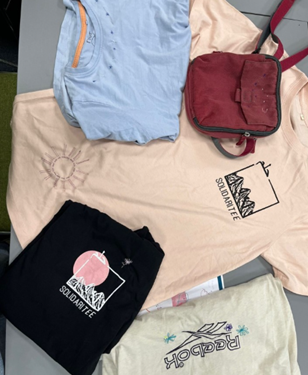
Our campaign was simple in premise – run a series of workshops and events to engage people in person and showcase our work on our digital channels to increase our reach. Our priorities were threefold –engage, educate and empower young people to recognise their own impact and consumption habits; we urged people to consider how best to reduce their reliance on the fast-fashion model that is exploitative to both people and planet. We established relationships with local small businesses, connected creatives with students and staff and ran a sustained digital campaign that engaged people nationally and internationally. Importantly, we helped provide students with the skills and understanding to repair their clothes and reduce their consumption.
The entire process, from outlining Stitch by Stitch to winning the Student Sustainability Fund, was one of the highlights of my time in Exeter. It was an incredible opportunity to collaborate with my friends, champion local small businesses and watch our idea blossom into something that continues to engage students in Exeter and beyond.
But importantly, it taught me that I had a place in the sustainability movement. It can be easy to see climate work as a vocation that requires you to take to the streets, to risk your safety, to shout the loudest. And these acts are vital and brave aspects of seeking an authentic climate justice, but they can be accessible. To only a privileged few. Just as important are the people behind-the-scenes – the organisers, the marketers, the creatives, the ideators, the funders – without these people we cannot hope to create a climate-just future that is both intersectional and inclusive.
Working on Stitch by Stitch was the pinnacle of my sustainability work thus far, because it nourished my community and welcomed new dialogue. It inspired and empowered students to see themselves of so much more than consumers, but creators of something bigger. And it proved that the sustainability industry must welcome everyone, for we cannot hope to get very far without as many voices, ideas and perspectives as possible.
A huge thank you to UPP Foundation for their guidance, support and belief in our project.
Did you know … as well as funding Stitch by Stitch, UPP Foundation supports the Exeter Tutoring Model, an initiative that seeks to tackle socio-economic inequalities in GCSE results, and – by association – support efforts to widen access to university. The model trains undergraduate students to tutor small groups of Year 8 pupils in foundational writing skills. As well as improving pupil attainment levels, the model also enhances students’ skills and experience, supports universities’ civic agendas, and potentially provides a pipeline of potential teachers. Now supporting partner universities to adopt and embed the model in their localities, you can read more about it a series of two blogs due to be published later this month.