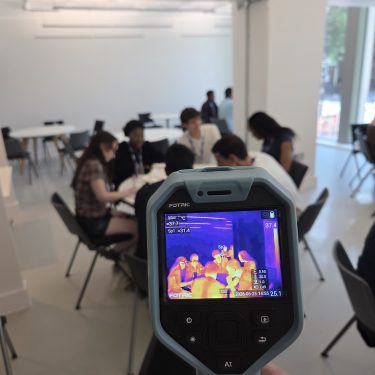
Since 2023, the UPP Foundation has supported the development of student-led university energy advice centres, first at London South Bank University and then at Kingston University, Reading University and Wrexham University. One aim of these centres is to create a generation of students who have an intuitive understanding of how we use energy in our homes, and the challenges we may collectively face if we want our houses, flats and halls of residence to move away from gas heating.
In the first of a series of three blogs, the LSBU team reflects on their experience in setting up and running the first Energy Advice Centre and their hopes for the future.

What’s it like to work in a university energy advice centre?
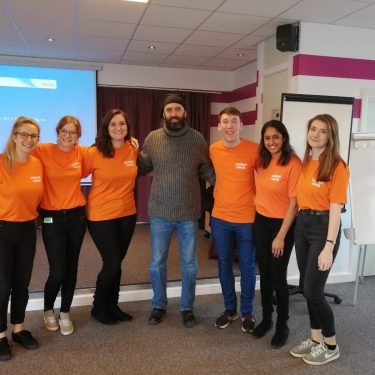
What is it like to work as a student energy adviser? Two of the LSBU staff give their answers below. Kristina Kerwin became the Director of the LSBU EAC when we started in 2023, and worked to create and develop the centre alongside her work as a PhD student. In 2026 she successfully completed her PhD in Design for the Circular Economy. Aaref Rahimi, a second year undergraduate chemical engineer, is our newest member of staff, and has been working in the EAC since April.
How did you end up working in the Energy Advice Centre?
Kristina Kerwin: I was a mature student and a mum, and I wanted to become an engineer. First I went to college and learned electrical engineering, and then that gave me the enthusiasm to want to move into higher education. I was always interested in how things are made, and so I joined Engineering Product Design at LSBU, and I fell in love with the university. I loved it so much, in fact, that I ended up working as a researcher here, and then I turned that research into a PhD. I’ve always wondered how we can do more to integrate our students’ skills with local businesses and local communities, and when the first discussions around the Energy Advice Centre started, I knew I wanted to be a part of it. It was so aligned with what I was already thinking.
Aaref Rahimi: I think I’ve wanted to study chemical engineering since before I knew what it really was. I studied high school in Iran, and I moved to the UK because of the reputation it has for education. I went to college in Bournemouth, and then used that as a stepping stone to study chemical engineering at LSBU. I wanted some practical way of using what I’m learning, and developing some new skills, and I’d heard about the Energy Advice Centre and decided to try it.
What did you want to get from working as part of this project?
KK: At first I just wanted to volunteer and to try to help our community. But early on I was offered a position as director of the EAC, and that gave me the opportunity to practice skills that I didn’t expect to be able to get. Actually running things can be challenging! But it’s also rewarding, and I’ve always felt like the decisions I make will have an impact on how successful we are. The other thing that I’ve really got out of it is the opportunity to make connections and be a part of a network of people who all want to create better homes for us all. This is a very hands-on, minds-on, kind of learning, and we’re all learning it together, including the people we’re trying to help, and that’s hugely rewarding.
AR: Initially I wanted to learn something practical. We were studying thermodynamics, and I thought, this must be relevant to how your home is heated and cooled. And it’s exactly that. We did a site visit with the EAC recently, and it was nice to learn some very practical things about building design, things I would never previously have thought to learn but found interesting. The second thing I wanted to get out of this is some new broad skills, partly for employability and partly for my own satisfaction. Straight away I was asked to create some posters for the upcoming student conference, and that gave me a chance to learn some new graphic design skills. And then the third thing for me that’s ended up being meaningful is that we’re giving people someone to talk to about things that are important in their lives. We’re a neutral third party, and that’s a good thing to be able to offer.
What would you like the Energy Advice Centre to be doing differently?
KK: We talk a lot about expanding this model beyond London. I think the new growth fund work with UPP is a good start, and what I’d really like is to work with universities in other countries. I’m from Latvia, Aaref is from Iran, and I think we see the international possibilities. And the needs in those countries are very different – for example, Latvia has a lot of post-Soviet infrastructure with district heating – so we’d always be learning. We’ve talked with Esther, another EAC student, about possibilities for cooling in Nigeria, where she’s from.
AR: I like the tangible work – site visits, outreach, talking to people. I find that work more satisfying than administrative work, like sending emails. So I think we should create more opportunities to actually go to places and meet new people. And from the site visits I did, it seemed like the people we were working with found the experience quite positive, and they felt like it was helping them to make progress, to move towards their goals.
What’s next for you?
KK: I’ve just finished my PhD, and the Energy Advice Work is on my CV, showing my skillsets, because you never know where you’re going to end up. I’m hoping to stay within academic and research positions. If I can go to another university, I can extend the Energy Advice Centre there!
AR: I can already see how I can link this into my degree – not just in pure thermodynamics, but thinking more generally about energy efficiency. The underlying principles are going to be useful for my third year. And then beyond that, for example, the design work I’ve been doing is helping me with my personal goals, building my skills, setting me up for the next challenge.
The first Student Energy Advice conference will take place at LSBU on the 25th June 2026, supported by UPP. It’s free to attend, and you can sign up at this link.